
Card identification
Japanese vs English Pokémon Cards: Collector’s Guide
A practical guide to telling Japanese and English cards apart, reading set identifiers, photographing cards clearly and choosing the right market reference.
Published
Start with the language on the card
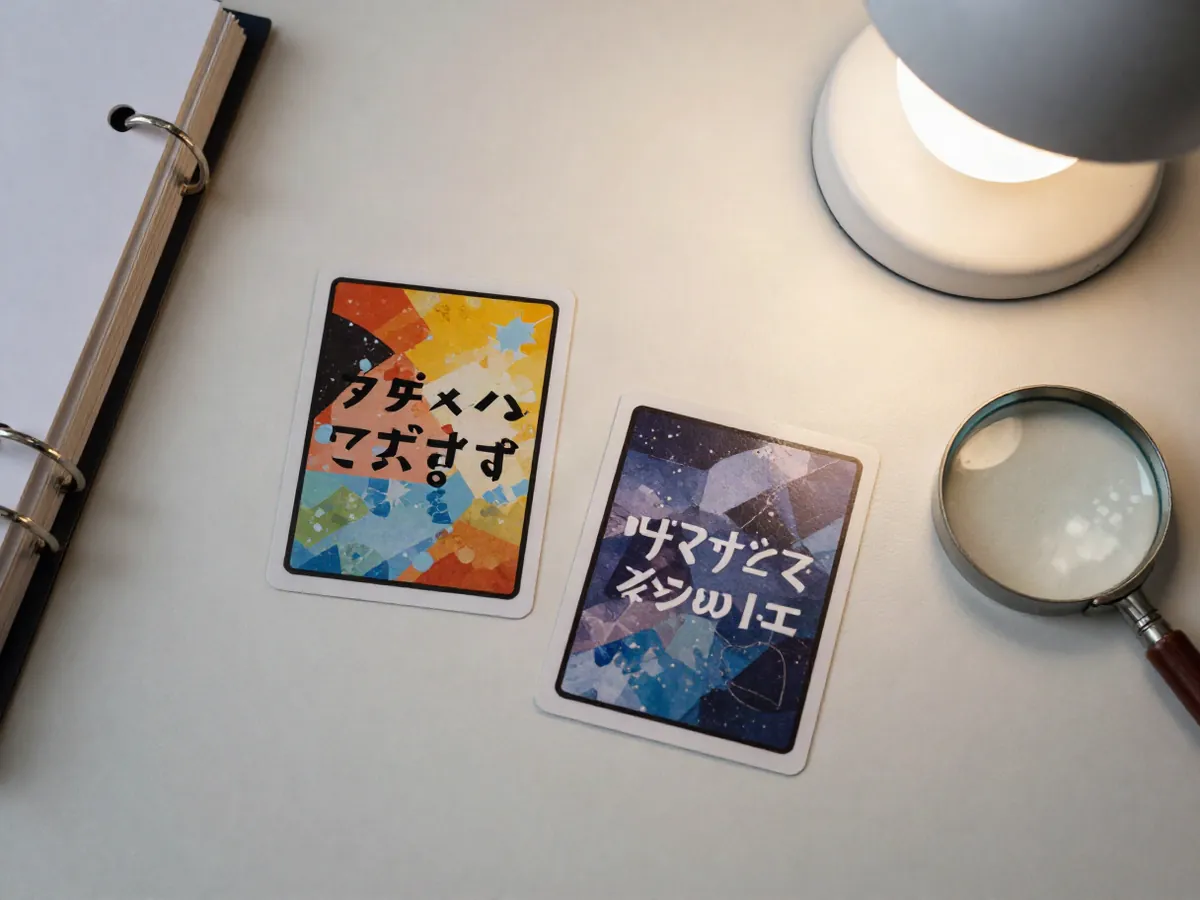
A Japanese and an English card can show the same Pokémon and artwork while still being different printings. Begin with the easiest clue: the language of the rules text, attack names, labels and copyright line. Japanese cards use Japanese writing; English cards use English. If the photo is blurry, zoom into the text box and the small line along the bottom edge rather than guessing from the illustration. Artwork may be reused across languages, so the picture alone cannot identify the version.
Language is part of the card’s identity, much like set and finish. A scan or collection record should preserve it explicitly. Do not assume that a card belongs to the English release just because the name is familiar, or that a Japanese card is an English card with translated text. Each market may have its own release schedule, product mix, card numbering and variants. Note the language before searching a database or comparing sales, then verify it with the other printed clues.
Read the set mark and collector number together
Look near the bottom edge for the set symbol or set code and the collector number. On many modern English cards, the number appears as a fraction-like pair, such as 123/198; the first number is that card’s position in the set and the second is the set total. Some special cards use numbers beyond the set total, letters, or a promo identifier. Japanese products and sets use their own codes and numbering conventions, which can differ from the English release even when cards share artwork or originate from related products.
Treat the full combination as an identifier: language, set mark or set name, complete number, and finish. A partial match can lead to the wrong printing. Record all characters, including letters, leading zeros, slashes and suffixes. If a symbol is too tiny to read, take a sharp close-up and compare it against a trusted card checklist or the official Pokémon TCG site. The English card number is not a translation key for the Japanese card; do not use one to infer the other.
Compare the physical layout, not just the artwork
Japanese and English versions can differ in borders, text placement, card dimensions, back design, rarity marks, holo patterns and the amount of information printed on the face. The exact differences depend on the era and card type, so avoid rules such as “all Japanese cards have this border” or “this symbol always means the same rarity.” Compare the card with a reference for the same language and product family. Look at the bottom line, set mark, number, rarity indicator and finish as a group.
A card may also have a language-specific illustration, promo treatment or special rarity even when its subject is familiar. Conversely, nearly identical fronts do not prove two cards are the same printing. If two candidates look alike, compare the full number and back, then check whether one is a promo, reprint, deck card or subset card. Keep photos of front and back in your collection notes; a single cropped image often omits the very clue that separates two versions.
Identify a printing from a photo
For a useful photo, place one card flat on a plain, non-reflective surface and use even light. Keep the entire front in frame, square the camera to the card, and tap to focus on the lower edge where the number and set mark sit. Avoid flash glare on foil areas. If the lettering is small, take a second close-up of the bottom corners and copyright line. A separate back photo helps confirm orientation and distinguish a card from a proxy or an unusual product insert.
When using a scanner, treat its match as a candidate rather than proof. Check that the language, set, number, artwork and finish all agree with the physical card. Foil glare, sleeves, rotation, soft focus and fingers covering the number can send recognition toward a similar card. Correct the lighting or angle and rescan; if it still does not match, search with the printed details. Save the original photo alongside your notes so you can revisit the identification without relying on memory.
Why market references differ by language
A market reference is tied to the exact version being tracked. English and Japanese cards are sold through different releases and channels, and each language can have different supply, demand, reprints, promotional distribution and collector interest. The same character or artwork does not make the two versions interchangeable. A listing for one language is not a reliable stand-in for the other, even when the front appears nearly identical.
Data sources can also differ in which sales they collect, how they label variants, and when they add a release. Before comparing references, confirm language, set, number, finish and condition, and check that the record describes the same printing. Look at recent completed sales where available, rather than treating asking amounts as transactions. Record the source and date with your number; references are snapshots of reported market activity, not offers to buy or appraisals of your card.
Common comparison mistakes
Most mix-ups happen when a collector stops at the character name or artwork. Several cards can share both while differing by language, set, finish, rarity or promo status. Search results may also group a family of related versions under one image. Take a moment to match every printed identifier before you use a reference in a trade discussion or collection total.
Use a consistent checklist each time you add a card. It prevents a small identification error from spreading into your inventory and later comparisons. If one detail is unreadable, mark it as unknown and keep the photo; do not fill the gap by assuming the most common version.
- Do not compare a Japanese card with an English listing just because the artwork matches.
- Do not omit letters or the denominator when recording a set number.
- Do not use a cropped front photo that hides language or lower-edge details.
- Do not treat a scanner’s first result as confirmation; verify the physical card.
- Do not compare different finishes, promos, reprints or conditions as if they were one version.
Worked example: from photo to matching reference
Suppose a photo shows a familiar full-art card, but the number is unclear. First identify the language from the rules text. Next photograph the lower edge and record the complete set mark and number. Compare those details with a checklist in the same language, then verify the finish and whether the card is a promo or part of a set. Only after the identity is clear should you look up a market reference, and that reference should describe the same language and printing.
If the matching entry is missing, keep the card details and photo together and try another reliable database or the official card information. A missing match only means that source has not identified the card; it does not establish rarity or value. For a group of mixed-language cards, keep separate rows in your inventory and use a tally to add only like-for-like references.
Quick answers
Can Japanese and English cards use the same artwork? Yes. Artwork may be shared, but language, set, number, finish and distribution still distinguish printings. Is one language always more valuable? No blanket rule works: compare the exact version and its own market activity. Can a photo alone prove authenticity? A clear image helps identify a printing, but it cannot establish authenticity with certainty; inspect the physical card and use appropriate verification for high-stakes decisions.
What if the set code is unfamiliar? Copy it exactly, include the language in your search, and consult a checklist or official card information. What if my scan returns a close but wrong match? Retake the photo with the full card flat and the bottom edge in focus, then search by number. When comparing references, remember that they describe market activity and are not purchase offers or appraisals.
Sources and further reading
- Pokémon TCG official site — Official card-game and set information.
- PSA Card Resources — General card collecting and authentication resources.
Keep exploring
All blog posts
How to build and track a Pokémon TCG deck list on your phone
Plan a legal 60-card list, scan the cards you own, track its changing reference total, and keep useful notes ready to export or share.
Read article
How to protect Pokémon cards: sleeves, top-loaders and binders
A practical guide to sleeves, rigid holders, binder pages and home storage, with simple habits that help preserve a card’s condition before you scan or handle it.
Read article