
Card identification
Holo, reverse holo and non-holo: telling printings apart
Where the foil sits, why one card number can carry several market values, and how to pick the right printing when a scan returns more than one match.
Published
The three finishes in plain words
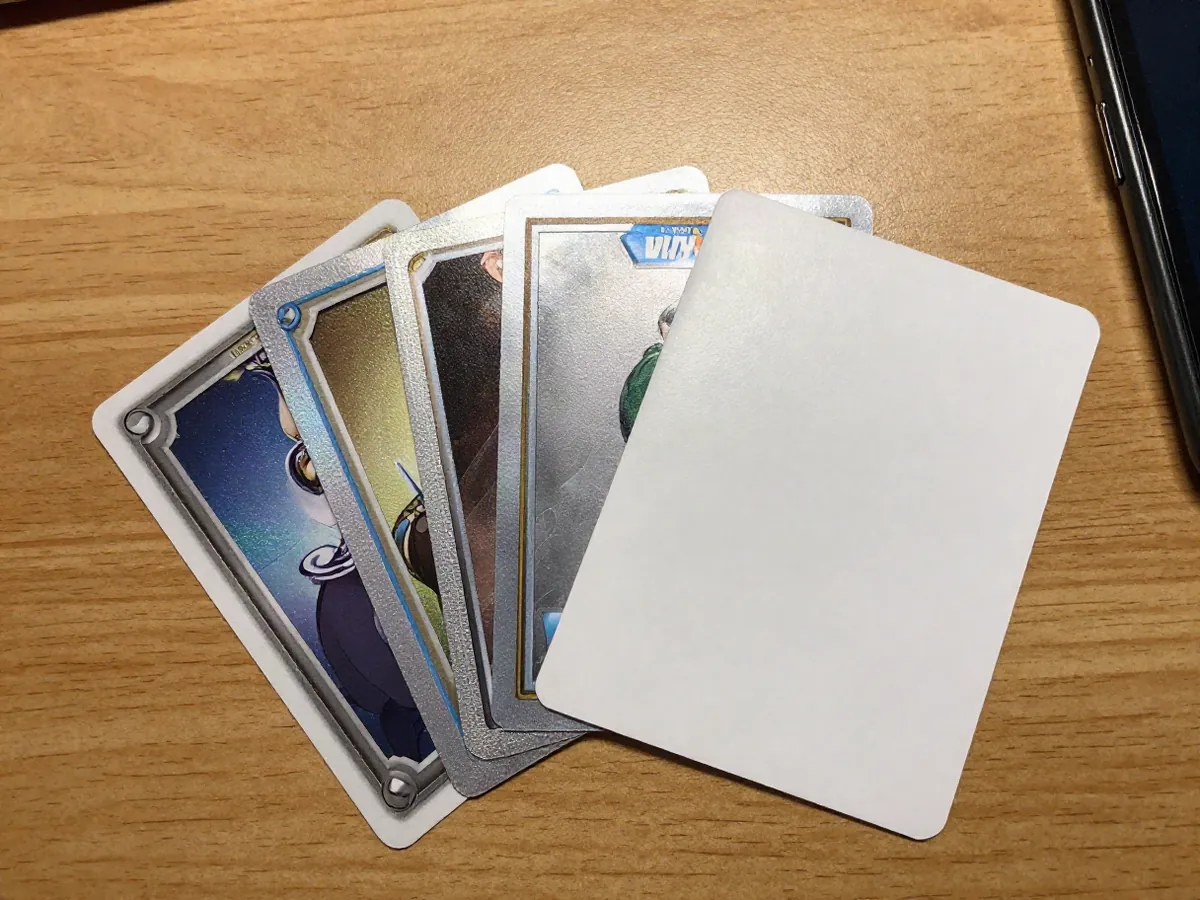
Many cards in a set exist in more than one finish. A non-holo card, often called regular or normal, has a flat surface with no foil pattern anywhere. A holo card, in the classic sense, has a foil-treated art window: the picture itself shimmers while the border and text box stay plain. A reverse holo is the mirror image. The art window is flat, but the rest of the card, including the border and the text area, carries a foil pattern.
All three can share the same name, the same artwork and the same collector number. That is why a card can look identical in a photo and still be a different printing. Finishes also vary by era and by set, and some sets add special foil patterns on top. Treat this article as a general guide and check the set's own checklist when something looks unusual.
Where the foil sits: a quick light test
Foil is easiest to judge by movement, not by staring at a flat photo. Hold the card under a single light source, such as a desk lamp or a window, and tilt it slowly forward and back. Watch which parts of the card catch the light and which stay dull. A few seconds of tilting usually answers the question.
Do the test on the front only, and compare against a card you already know is non-holo from the same set. Seeing a matte and a foil card side by side makes the difference far more obvious than judging one card alone.
- Holo: the art window shimmers or shows a rainbow sheen, while the border and text box look flat.
- Reverse holo: the art window looks flat, while the border, text box background and sometimes the set symbol area shimmer.
- Non-holo: nothing on the card shows a foil pattern, only a uniform matte or satin surface.
Why one card number has several values
Market data usually lists each finish as its own product. The holo, the reverse holo and the non-holo of the same card number are tracked separately because collectors treat them as different items, and because the number of copies in circulation is not the same. A common card may be easy to find as a non-holo and noticeably scarcer in a particular foil, or the other way around.
That is the reason a single card number can show several different market values side by side. Those values are references drawn from past sales and listings. They are not offers, not appraisals and not a promise of what a buyer will pay. Condition, language, edition and the exact printing all move the number, so the finish is only one of several things to confirm.
Choosing the right printing in a scan result
A scanner can read the artwork, the name and the collector number with good reliability. What it cannot always do from a single photo is tell which foil pattern the physical card has, because the artwork is identical across finishes. When a result shows more than one printing, the final choice is yours, and it takes only a moment.
Make it a habit to confirm the finish with the card in your hand, not with the image on the screen. Foil is a property of the object, and a photo flattens it. The steps below keep the process quick, even for a large stack.
- Scan in even light and keep the whole card in frame, so the name and the number at the bottom are readable.
- Check the set symbol and collector number printed on the card and make sure they match the result you are looking at.
- If the result offers several printings, tilt the real card under a lamp and match what you see to holo, reverse holo or non-holo.
- Save the selection and keep going. For a big batch, work through a checklist so every card gets the same checks in the same order.
A worked example: sorting one stack
Imagine you have pulled three copies of the same common card from a box. In the scan result, all three match the same name and collector number, and the app lists a holo, a reverse holo and a non-holo version of that number. The listed market values differ for each, so picking the wrong one would change your total.
Pick up the first copy and tilt it under your desk lamp. The art window stays dull but the border ripples with a repeating pattern: that is the reverse holo. The second copy has a glittering art window and a flat border: that is the holo. The third shows no shimmer at all, so it is the non-holo.
Now record each one against the matching printing and note the condition separately. Doing this once per card turns a confusing list of near-identical results into a clean inventory you can trust when you compare, trade or decide what to keep.
- First copy: shimmer in the border only, so reverse holo.
- Second copy: shimmer in the art window only, so holo.
- Third copy: no shimmer anywhere, so non-holo.
Common mistakes to avoid
Most wrong printings come from rushing. A few repeat offenders are worth knowing before you sort a box, because a wrong finish can silently distort the total of a collection.
- Judging in flat, dim light where foil does not show. Always tilt the card.
- Assuming every card exists in all three finishes. Some rarities have only one, and some sets skip a finish entirely.
- Confusing texture or a full-art look with holo. A textured surface is a different treatment from a foil pattern.
- Mistaking surface scratches or play wear on a non-holo for foil. Wear catches light in random lines, while foil follows a repeating pattern.
- Accepting the first match without comparing the collector number and set symbol.
Quick FAQ
Is a reverse holo a holo? Not in the sense most collectors mean. A holo has foil on the art window, a reverse holo has foil everywhere except the art window, and both are listed as separate printings.
Why does my scan show several versions of the same card? Because the name, art and number are shared across finishes. Pick the one that matches the foil on your physical copy, then double check the set symbol.
Can I tell the finish from a photo someone else sent me? It is unreliable. A single still image hides how foil moves under light, so ask for a short video or a couple of photos at different angles before you rely on it.
Sources and further reading
- Pokémon TCG official site — General background on the trading card game and its card types.
- PSA Card Grading — Background on card condition and grading terms.
Keep exploring
All blog posts
How to scan trading cards with your phone and get a clean match
Light, glare, focus, framing and sleeves decide whether a scan lands on the right card. Here is how to fix each one, and what to do when the first match is the wrong printing.
Read article
Pricing cards from a brand-new set: what to expect in the first weeks
Delta Reign is out on 6 November 2026. Here is why early market references are thin, why a new set can be missing from price data, and how to note dates and decide when to wait.
Read article