
Card identification
How to find a Pokémon card's set and card number
The set symbol and the collector number are small, but together they tell you exactly which printing is in your hand. Here is where to look, and what to do when they are missing.
Published
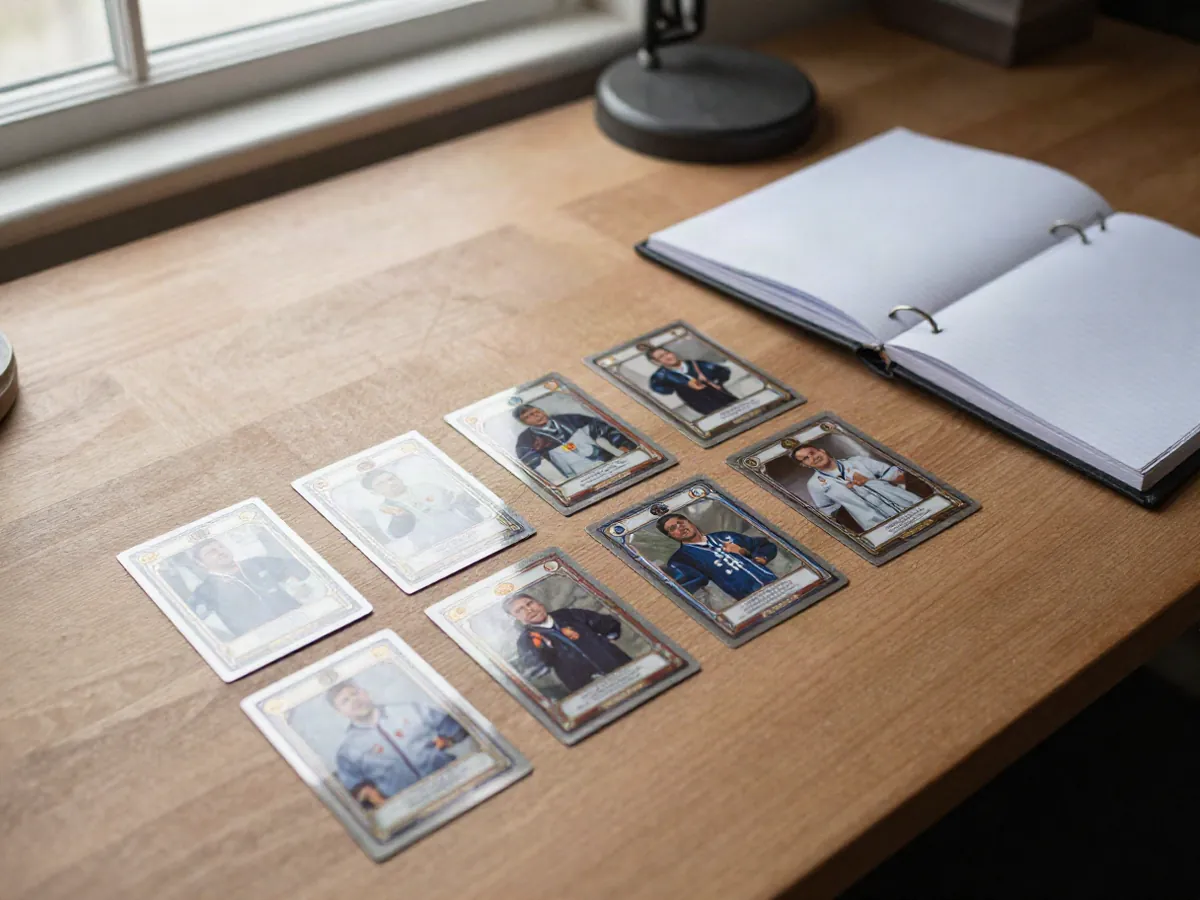
Start at the bottom edge of the card
Almost everything you need to identify a printing sits along the bottom of the card. On modern Pokémon cards, look at the lower-left or lower-right corner of the card face, below the artwork and the attack text. You will usually find a small set symbol, a collector number, and a few other marks such as the illustrator credit and a copyright line.
Do not start with the name or the artwork. The same Pokémon has been printed dozens of times across many sets, often with similar art. The bottom edge is where the card tells you which of those printings you actually own, so train yourself to flip your eyes there first.
Reading the set symbol
The set symbol is a tiny icon that marks the expansion a card belongs to. On older cards from the early 2000s and before, it often sits on the right side of the card, just below the artwork. On more recent cards it moves down to the bottom corner, close to the collector number. Newer Scarlet & Violet era cards also print a short set code next to the number, which makes matching much easier.
A symbol on its own is not always enough, because some expansions use symbols that look alike at a glance, and a few sets share a visual theme. Treat the symbol as a first filter, then confirm with the number and the set total.
- Use good light and hold the card at a slight angle so holographic foil does not wash out the icon.
- If the symbol is too small to read, zoom in on a photo instead of squinting at the card.
- Compare the symbol against a set list or checklist rather than relying on memory.
Understanding the collector number
The collector number is usually printed as two figures separated by a slash, for example 025/198. The first figure is the card's position in the set. The second is the number of cards in the main numbered set. Together they act like a short address: the set narrows the neighbourhood, the number picks the house.
Sometimes the first figure is larger than the second, such as 199/198. That is normal. Many modern sets include extra cards, often secret or special rarities, that are numbered beyond the official total. A number that overshoots the total is a clue that the card is one of these extras, not a misprint.
Why the number decides which printing you have
Two cards can share a name and still be different products. A Pokémon may appear in a standard set, in a later reprint, in a special illustration version and in a promo, each with its own number. Market references, population counts and grading records are all attached to the specific printing, so the wrong number sends you to the wrong data.
The number also separates variants inside one set. Reverse holo versions of a card typically carry the same number as the regular version, so the number alone will not tell those apart; you also need to look at the finish. On the other hand, full-art and alternate-art versions usually have their own higher numbers. Always record the full number with the set total, not just the first figure.
Older cards, missing numbers and promos
Not every card follows the modern pattern. Some of the earliest cards have no set symbol at all, and some older sets print numbers in a different spot or style. Others, especially certain promos and event cards, have no slash-style number. When a card seems to have nothing, check the corners, the area beside the illustrator line and the very bottom edge before assuming it is blank.
Promotional cards usually carry a code instead of a normal fraction, often a few letters followed by digits, and many show a star-shaped mark in place of a regular set symbol. The letters point to the promo series they came from. Because promos are not part of a numbered main set, the code is the identifier, so copy it exactly.
- No visible number: look again under magnification, then use the name, artwork and card type to narrow it down.
- A promo code: search the code itself rather than the card name.
- A card from a very old set: compare the layout, border and text style with checklist images, since small design details separate printings.
Mistakes that lead to the wrong match
Most misidentifications come from rushing. People match a name, see one familiar picture, and stop. A few habits will keep you accurate when you are sorting a large pile.
- Reading only the first figure of the number and ignoring the set total, which is often the quickest way to tell similar sets apart.
- Assuming a reverse holo or a stamped version is a separate number when it often is not.
- Trusting a symbol that is partly hidden by foil glare or a worn edge.
- Mixing up cards from a reprint set with the originals because the artwork is identical.
Quick answers and a repeatable routine
People often ask whether a card is fake if the number looks odd. A number above the set total, or a missing slash on a promo, is usually normal. Judge authenticity from several signs together, not from the number alone, and remember that nothing here replaces a trusted grader's opinion. If a card is not in any list you check, photograph it clearly, note every mark you can read, and compare against more than one source.
A simple routine works well: photograph the bottom edge, read the symbol, read the full number, look up the set, then confirm the artwork and finish. If you are sorting many cards, the card scan checklist in Card Value Scanner keeps those steps in order so you do not skip one. Any market figures you later look up are references to the market at a point in time, not offers or appraisals.
Sources and further reading
- Pokémon TCG official site — Official overview of the trading card game and its expansions.
- PSA Card Resources — Grading company resources for identifying and verifying cards.
Keep exploring
All blog posts
Card condition explained: near mint, lightly played and more
A plain-language walkthrough of the raw condition scale, what to check on corners, edges, surface and centering, and why wear changes what a card can sell for.
Read article
Market price vs sold price: which number to trust
A market price is a summary, a sold listing is one sale. Learn what each number tells you, how fees and shipping change it, and how to pick one for a trade.
Read article