
Card condition
Card condition explained: near mint, lightly played and more
A plain-language walkthrough of the raw condition scale, what to check on corners, edges, surface and centering, and why wear changes what a card can sell for.
Published
Why condition matters
Two copies of the same card can sit in very different places on the market. The artwork, set number and rarity match, yet one sells quickly at a strong figure while the other lingers. The usual reason is condition: how much wear a card shows after printing, packing, sleeving, trading and playing.
For raw, ungraded cards, condition terms are a shared vocabulary between buyers and sellers. Getting comfortable with them helps you describe your own cards honestly, spot over-optimistic listings from others, and decide whether a card is even worth sending to a grading company. It also keeps trades fair: when both sides use the same words for the same wear, there is far less room for a disagreement after the card arrives. Keep in mind that condition is separate from rarity, and that a card that looks fine inside a sleeve can look quite different once it is out, under a light, and in your hand.
The common condition terms
Most English-language marketplaces use a five-step scale. Exact wording differs by platform, so read the definitions of the place you are using, but the order is consistent. TCGplayer publishes its condition guidelines in its help center, and they make a good reference point.
Graded slabs use a separate 1 to 10 numeric scale, and PSA's grading standards are public. Do not mix those numbers up with raw terms: a raw Near Mint card is not automatically a PSA 8 or 9, and nobody can promise what grade a raw card will receive.
- Near Mint (NM): looks almost as it did when pulled from the pack. A tiny white speck on an edge or a faint surface mark is acceptable, but nothing should catch your eye at arm's length.
- Lightly Played (LP): minor wear is visible, such as light edge whitening, a few small scratches or slight corner softness, yet the card still looks clean overall.
- Moderately Played (MP): obvious wear, including widespread edge whitening, noticeable scuffing or visibly rounded corners. There is still no structural damage.
- Heavily Played (HP): heavy wear with major whitening, deep scratches, or light bends that you can see at a glance.
- Damaged (DMG): creases, tears, water damage, peeling, writing or anything that changes the card's structure beyond ordinary wear.
What to look at: corners, edges, surface and centering
Condition is the sum of four things, and a weakness in one can pull the whole card down a step. Check them in the same order every time so you never skip one. A useful habit is to score each of the four on its own, for example clean, minor or major, and only then settle on one overall label. That stops a lovely surface from distracting you from a soft corner, and it gives you something concrete to point to if a buyer asks why you chose a particular grade.
Keep in mind that print lines and factory flaws can appear on a card that has never been played. Some sellers still call such a card Near Mint, but careful buyers may discount it. If you spot a flaw like that, mention it in your description rather than hoping nobody notices.
- Corners: look for fraying layers, whitening, rounding or dings. Corners show wear first because they take every knock.
- Edges: whitening appears fastest on the back edges, especially on dark-bordered cards. Chips and nicks count for more than an even, light whitening.
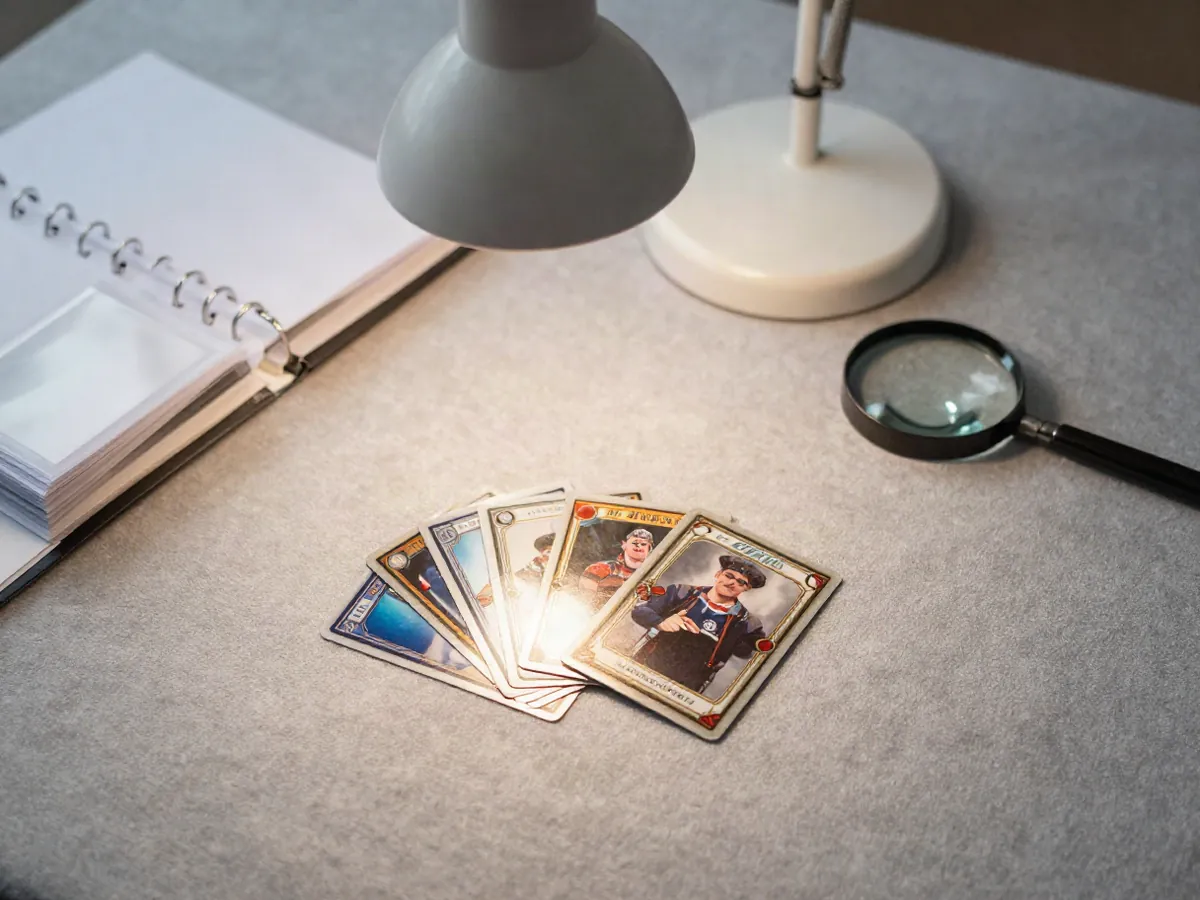
- Surface: scratches, scuffs, print lines, dents, stains and holo scratching. Tilt the card under an angled light to reveal what flat light hides.
- Centering: how evenly the border sits left to right and top to bottom. It is a printing trait rather than wear, but it affects appeal and matters a lot for grading.
A simple inspection routine
You do not need special equipment. A clean flat surface, a bright light you can angle, a soft cloth, and optionally a magnifier or your phone camera in close-up mode are enough. Wash and dry your hands first and hold each card by its edges. Work over a soft surface so that an accidental drop does not add the very damage you are trying to assess, and keep drinks well away from the table.
Photograph in daylight or neutral light against a plain background. Flash can hide scratches and also create glare on holofoils, so for shiny cards take one photo with it and one without.
- Look at the front straight on in even light, then tilt it slowly to catch scratches and dents.
- Repeat on the back, paying attention to whitening along all four edges.
- Inspect each corner up close and compare all four, since one bad corner often decides the overall condition.
- Run your eye along each edge, then check centering by comparing the borders on opposite sides.
- Decide the condition by the weakest feature, write down the flaws, and keep clear photos of the front, back and any flaw.
How condition changes the value you can expect
In general, the more wear a card shows, the lower its sale value compared with a Near Mint copy. The gap tends to be larger for scarce or sought-after cards than for common ones. How big it is depends on the card, the set and the current market, so there is no fixed percentage that applies to everything. A modern common card may barely move between Near Mint and Lightly Played because its value is already small, while a sought-after card can behave very differently across the same two steps. That is why sorting a collection by condition first, and only then looking at market data, tends to give a more realistic picture than applying one rule to the whole pile.
The practical way to estimate is to look at recently sold listings for your card in the same condition rather than at asking figures. Marketplaces such as TCGplayer show condition-specific market data, which makes it easier to compare like with like. Treat any figure as a reference, not an offer or an appraisal, because a real sale depends on the buyer, shipping and timing.
Common mistakes when judging condition
Most disputes come from optimism. Sellers see the card they remember, while buyers see every flaw under a bright light. A few habits keep you honest.
If you are unsure between two grades, choose the lower one for your listing. A buyer who receives a card better than described is happy, and one who receives something worse is a return.
- Judging only the front. Back edges and corners often reveal wear that the face hides.
- Using one soft light. Scratches on holos and textured cards vanish under diffuse light.
- Inspecting through a sleeve or toploader. Take the card out and handle it gently before you judge it, because sleeves can hide edge wear and scuffs that only show once the card is bare.
- Confusing centering with condition. Off-center cards can be otherwise flawless, and careful sellers describe that separately.
- Ignoring creases. A crease usually drops a card to Heavily Played or Damaged no matter how clean the rest looks.
Quick answers
Is Near Mint the same as mint? No. Most raw scales have no Mint step, and Near Mint is the top. The word Mint belongs more to graded scales and some older descriptions.
Can I clean a card to improve its condition? It is best not to. Rubbing, solvents and polishing can leave marks that make a card Damaged. Blowing off loose dust or using a dry, soft cloth is as far as most collectors go.
Does condition matter if I only collect to play? For play, sleeves hide most wear, so it matters less. It matters again the moment you want to sell or trade.
Sources and further reading
- TCGplayer Help Center: card condition guidelines — Search the help center for the condition guide used by this marketplace.
- PSA Grading Standards — Public description of the 1 to 10 grading scale for graded cards.
Keep exploring
All blog posts
Market price vs sold price: which number to trust
A market price is a summary, a sold listing is one sale. Learn what each number tells you, how fees and shipping change it, and how to pick one for a trade.
Read article
Holo, reverse holo and non-holo: telling printings apart
Where the foil sits, why one card number can carry several market values, and how to pick the right printing when a scan returns more than one match.
Read article